
University of Montana Announces Major Expansion of Climate Science Program |
University of Montana receives major NSF grant to build new climate research facility and double program capacity. |
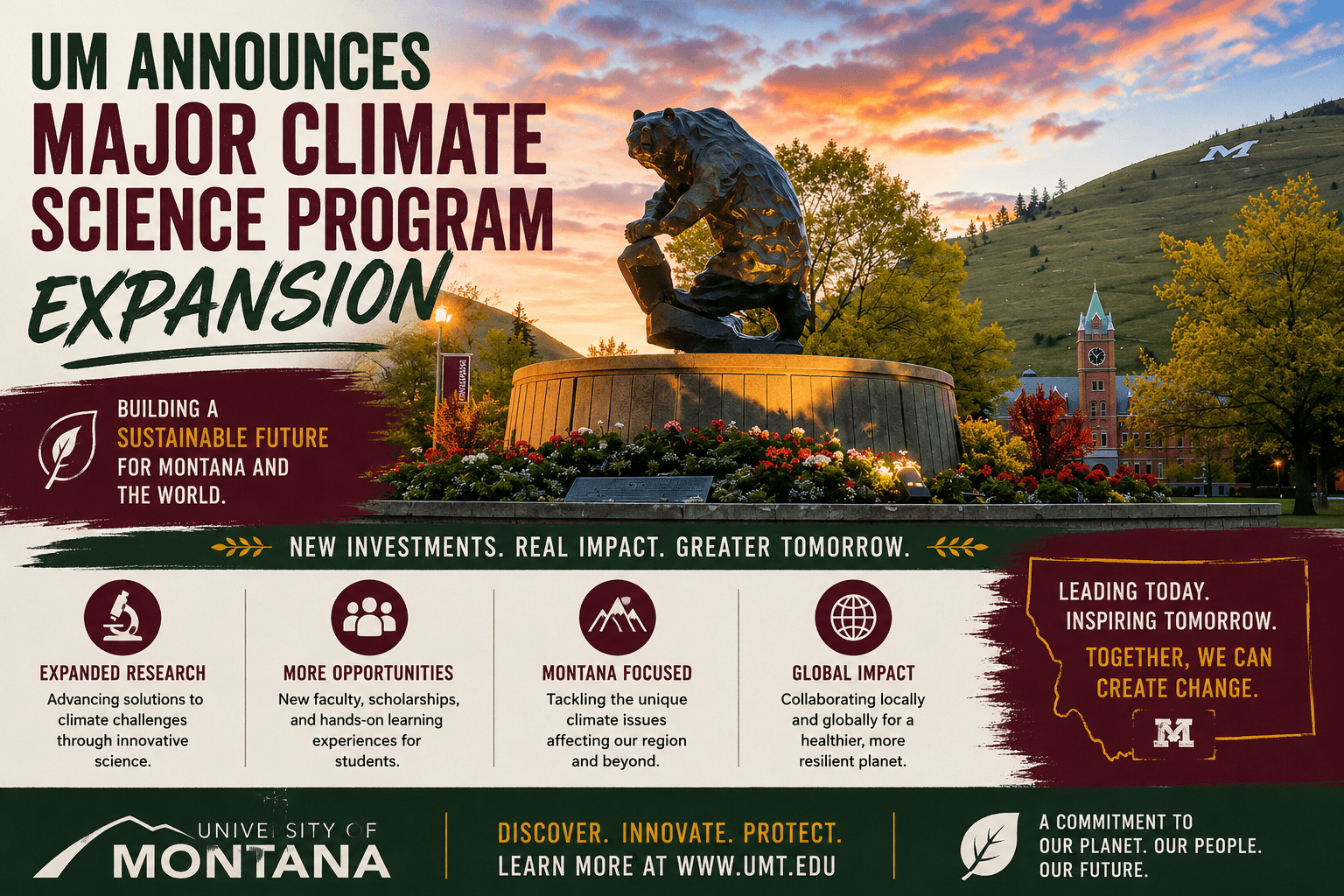
UM Secures Landmark Climate Research Funding
University of Montana climate research received a major boost this week with the announcement of a $15 million federal grant to expand the Climate and Fire Science Program.
The National Science Foundation grant, one of the largest research awards in UM's history, will fund construction of a new Climate Science Research Facility on campus and support hiring of additional faculty and research staff over the next five years.
The expansion positions the University of Montana as a leading institution for climate change research in the Northern Rockies, particularly focused on understanding how rising temperatures affect Montana's forests, water resources, and wildfire patterns.
New Research Facility Plans
The planned UM Climate Science facility will occupy a 45,000 square foot building on the eastern edge of campus near the existing Forestry Sciences Laboratory.
The three-story structure will house advanced climate modeling laboratories, a fire behavior research wing, and collaborative workspaces designed to bring together researchers from multiple disciplines. Construction is expected to begin in spring 2027 with completion targeted for fall 2028.
The facility will feature state-of-the-art equipment including climate simulation chambers, advanced computer modeling systems, and laboratory space for analyzing tree rings, soil samples, and other climate indicators. A public education center on the ground floor will host exhibits explaining climate science and Montana-specific research findings.
Designed to achieve LEED Platinum certification, the building itself will demonstrate climate-conscious construction through solar panels, geothermal heating and cooling, and water conservation systems.
Research Focus Areas
The expanded program will concentrate on three primary research areas particularly relevant to Montana and the broader Northern Rockies region.
Wildfire behavior and prediction research will examine how changing climate conditions affect fire seasons, intensity, and spread patterns. Researchers will work closely with the U.S. Forest Service and Montana Department of Natural Resources to translate findings into improved fire management strategies.
Montana has experienced increasingly severe fire seasons over the past two decades, with longer burning periods and larger fire footprints. Understanding the climate-fire connection helps communities prepare and protects both human lives and natural resources.
Water resource sustainability studies will focus on snowpack trends, glacier retreat, and stream flow patterns. Montana's rivers begin in mountain snowpack that serves as a natural reservoir, but warming temperatures threaten this reliable water source for agriculture, municipalities, and ecosystems.
Researchers will model future water availability scenarios to help water managers plan for changing conditions. This work directly impacts Missoula's water supply, agricultural irrigation in western Montana, and habitat for native fish species.
Forest ecosystem adaptation research examines how Montana's forests respond to temperature increases, altered precipitation patterns, and pest pressures. Scientists will study which tree species thrive under changing conditions and how forest composition might shift over coming decades.
This research informs sustainable forestry practices and helps land managers make decisions about species selection for reforestation projects.
Student and Community Benefits
The program expansion will more than double capacity for graduate students pursuing climate science degrees at UM.
Current enrollment of approximately 45 graduate students will grow to 100 or more over five years. The program will offer increased funding for graduate assistantships, making UM more competitive in recruiting top students nationally and internationally.
Undergraduate students majoring in environmental science, forestry, ecology, and related fields will gain access to cutting-edge research facilities and opportunities to participate in faculty-led research projects. The hands-on experience positions graduates for careers in climate science, environmental management, and natural resource policy.
Community education represents another program priority. Free public lectures, workshops, and school programs will help Montanans understand climate science and its local implications. The public education center will host school field trips, giving K-12 students exposure to real scientific research.
Economic Impact on Missoula
Beyond scientific contributions, the program expansion brings economic benefits to Missoula and western Montana.
Construction of the research facility will create temporary jobs and inject approximately $15 million into the local economy through materials, labor, and associated spending. Once operational, the facility will employ 30-40 full-time research staff, faculty, and support personnel.
Graduate students contribute to Missoula's economy through housing, food, and services spending. The expanded program will bring an additional 50-60 students to Missoula, supporting local landlords, restaurants, and businesses.
Research grants typically generate additional economic activity as visiting researchers, conference attendees, and collaborative partners visit Missoula for meetings and fieldwork.
Collaborative Partnerships
The UM climate program will strengthen existing partnerships and forge new collaborations with regional institutions.
The U.S. Forest Service Rocky Mountain Research Station maintains a significant presence in Missoula. The expanded UM program will enable deeper collaboration on forest and fire research, with scientists from both institutions working side-by-side in the new facility.
Montana State University in Bozeman will partner on water resources research, combining MSU's agricultural expertise with UM's ecosystem focus. The University of Montana Western in Dillon will collaborate on grassland ecosystem studies.
Tribal partnerships represent a program priority. Researchers will work with the Confederated Salish and Kootenai Tribes, Blackfeet Nation, and other Montana tribes to incorporate traditional ecological knowledge and address climate concerns affecting tribal lands and resources.
National Recognition for Montana Research
The NSF grant selection reflects growing recognition of Montana's importance in climate research.
As a largely rural state with vast public lands, extensive forests, and significant water resources, Montana serves as an ideal natural laboratory for studying climate impacts in western ecosystems. Research conducted here provides insights applicable throughout the Intermountain West and Northern Rockies.
University President Seth Bodnar noted that this grant positions UM among the nation's elite climate research institutions, raising the university's profile and enabling it to compete for additional major research funding.
Timeline and Next Steps
The program expansion will roll out in phases over the next five years.
Immediate priorities include hiring a facility director and beginning architectural planning for the new building. Faculty recruitment will begin this fall for positions starting in 2027. Graduate student recruitment for expanded cohorts begins immediately, with the first larger class arriving in fall 2027.
Community members interested in the program's public education offerings can sign up for email updates through the UM Climate Science Program website. School teachers can register interest in field trip programs that will launch once the facility opens.
Climate Science Meets Montana Values
For Montanans concerned about preserving the state's natural heritage, outdoor recreation opportunities, and resource-based economy, this research investment addresses practical concerns.
Understanding climate change isn't abstract science—it's about protecting Montana's forests, ensuring reliable water supplies, managing wildfire risk, and preserving the landscapes and resources that define the state.
The University of Montana's expanded climate science program puts Montana at the forefront of research aimed at understanding and adapting to environmental changes, with benefits extending far beyond campus to communities throughout the region. |
0 Comments
Join the conversation
Be the first to comment
Share your thoughts above.