
Missoula Banned Data Centers Last Month. Now a Local AI Company Is Suing. |
CubCloud AI says the city's October zoning amendment violates Montana's Right to Compute Act. The city attorney says nobody yet knows what that law means. |
In October, the Missoula City Council closed a gap in the city’s zoning code that had been letting data centers open almost anywhere in town. On Nov. 4, a Missoula company that had been operating inside that gap sued the city to undo it.
CubCloud AI filed in Missoula District Court, where the case has landed with Judge Shane Vannatta. The company argues the amendment violates a state law so new that the city attorney says nobody is sure what it does yet.
What the city actually changed
Missoula adopted a new zoning code in late 2025, which took effect earlier this year. It allowed data centers in heavy industrial areas — but, as Montana Free Press reports, the rules inadvertently permitted them citywide so long as the computing equipment took up less than half of a building.
October’s amendment closed that loophole. It redefined what counts as a data center and regulates the facilities by how the equipment is used rather than how much floor space it fills. KPAX reports the effect is close to a prohibition inside city limits, with some small-scale uses still allowed.
Why it lands on CubCloud
CubCloud runs a facility on Kestrel Drive, near Missoula Montana Airport. Under the old rules it complied comfortably: the computing hardware occupied about 20% of the floor area. Chief executive Joshua Rhines had been planning a new stand-alone building on the same site.
Under the amendment, according to the complaint, the company could not build that facility there — or anywhere else in the city. The company, founded about a year ago, says it employs 18 people.
The law nobody has tested
The claim rests on the Right to Compute Act, passed by the Montana Legislature in 2025 and described by one of the groups backing the suit as the first law of its kind in the country. It ties the development of computational resources to constitutional rights, and limits government interference unless there is a compelling interest such as public health and safety — and even then, the rule must be narrowly tailored.
CubCloud argues the amendment fails both halves of that test, and that its facilities produce no noise, odor or other nuisance. It is represented by the Big Sky Legal Project, founded in cooperation with the Arizona-based Goldwater Institute, with the Montana-based Frontier Institute also involved. The company is asking the court to declare the rule unlawful and to stop the city enforcing it. It is not asking for damages.
Goldwater’s Dave Roland put the argument bluntly in a press release: “The City’s new ordinance targets data centers because it considers them the wrong type of business.” Kendall Cotton, president and chief executive of the Frontier Institute, told KPAX of CubCloud: “They’re doing it right.”
What the city says
City Attorney Ryan Sudbury told Montana Free Press the city had not been served as of Monday morning but was aware of the case, and that officials had discussed the Right to Compute Act internally while drafting the amendment.
“Nobody knows what the law is intended to do or what it means,” Sudbury said. “It has not been tested in court. … If we get served, we will defend the city’s action.”
In a written statement to KPAX, the city said it is its position that the Right to Compute Act does not give data center companies what they are claiming, that it “plans to vigorously defend the City Council decision in this case,” and that it will not discuss specifics during pending litigation.
And it may not stop here
Council member Kristen Jordan is working on a two-year moratorium on heavy industrial uses, which Montana Free Press reports was prompted by AI data centers and is likely to reach the council in the coming weeks.
“We don’t want to violate the Right to Compute law, but we have to look at our resources,” Jordan said.
That is the tension in one sentence. Missoula County’s recently released data center study found that even small-scale operations can carry significant impacts on energy demand, water use and air and water pollution — and the county is drafting rules of its own. The city and the county are separate governments, moving separately, under a state law neither has seen a court interpret.
Background: the county study that reached the Land Use Board last week.
Sources
|

Nov 4, 2026
Missoula Eats & Treats: Two Taco Shops Close in a Month
Taco Sano closed on the Hip Strip on October 30, citing a building slated for demolition and a lease that did not add up. Taco Del Sol is going too.
Nov 4, 2026
Kratom Comes Off Missoula Shelves
Missoula health inspectors begin checking that retail food businesses are not selling kratom. What the rule covers, what it does not, and who to call.
Nov 4, 2026
Davis Leads All of Division I in Receiving Yards
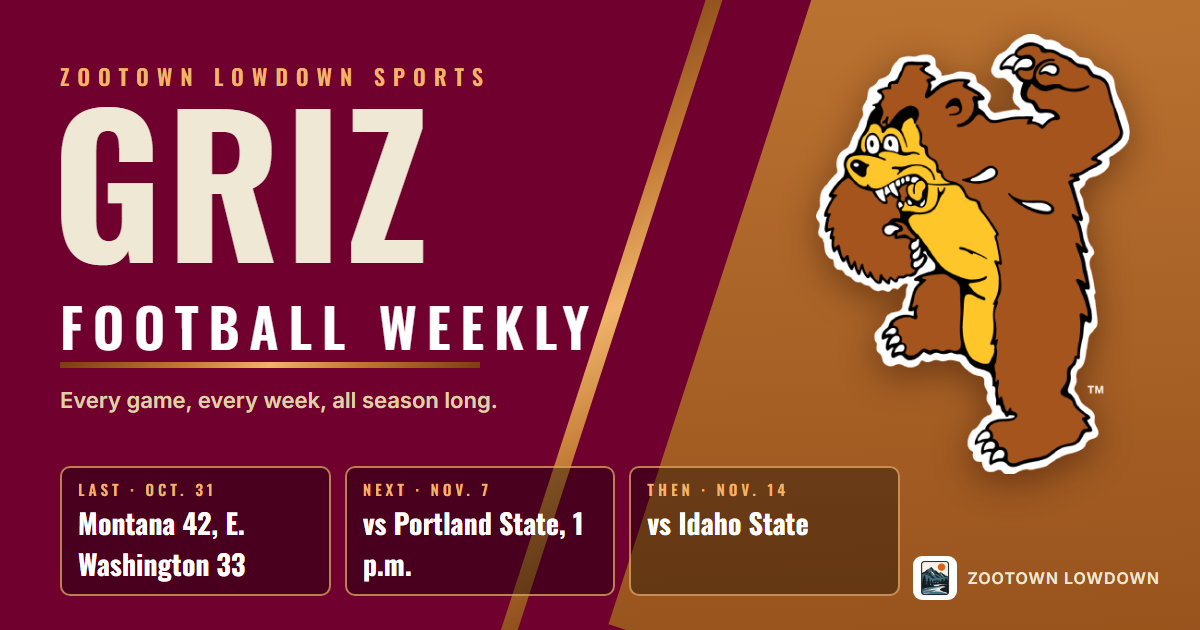
Brooks Davis caught nine passes for 231 yards and three touchdowns at Eastern Washington. Montana is 6-3 and hosts Portland State on Saturday at 1 p.m.
Nov 4, 2026
Missoula Backed Forstag More Than Two to One, and It's Still Uncalled
Polls closed at 8 p.m. Tuesday in Missoula County. Where the official Nov. 3 results post, how they're labelled, and why the count takes time.
0 Comments
Join the conversation
Be the first to comment
Share your thoughts above.